How Are Large Orders and Small Orders Handled Differently in Bag Production?
Many clients don't understand why factories have minimum order quantities (MOQs), assuming small orders can be completed quickly while large orders require more time. Therefore, clients often request small orders to be completed within 15 days, which factories frequently cannot meet. This is because order quantity affects the factory's scheduling, processes, quality control, and cost structure.
Therefore, for buyers, understanding the difference between small and large orders will help them develop project plans, rationally arrange sampling and delivery dates, and avoid inconsistent quality and delivery delays.
1. Small Orders VS Large Orders
First of all, what constitutes a large order and a small order?
Actually, the understanding of order size varies across industries, considering not only quantity but also value. For the handbag industry:
Large orders: Orders exceeding 5000 pieces, even tens of thousands.
Small orders: Orders below 1000 pieces, even below 500 pieces. Different quantities require different factory scheduling strategies, personnel input, and cost structures.
2. Differences in Production Scheduling
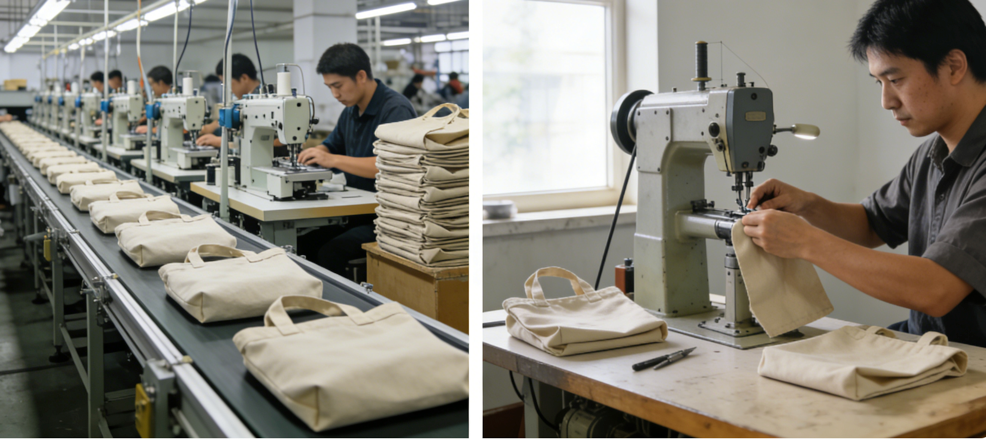
1) Large Order Arrangement: Large orders are often handled with a complete production line to ensure continuity and sustainable production capacity. Assembly line operations are used, with professional QC monitoring during production to ensure consistent quality.
Advantages:
Low unit cost
Stable quality
High production efficiency
Disadvantages:
Low flexibility, difficult design changes
Requires high production capacity
Complex management
2) Small Order Arrangement: Small orders generally cannot be arranged on a separate production line due to insufficient output to maintain continuity. Therefore, they are usually inter-orders, produced on mixed lines with other orders. Experienced technicians are typically used to ensure quality. Scheduling is unstable and easily affected by large orders.
Advantages:
Flexible and easily adjustable
Quick trial production
Disadvantages:
High unit product cost
Affected by large orders, low production efficiency
- Differences in Process
- Large orders: These typically follow standardized operating procedures. Order materials require die-cutting to minimize dimensional deviations. Mass production can only begin after sample confirmation. Large orders are suitable for mass-produced products, tea varieties that have undergone repeated trials and proven stable, and simple products with controllable costs.
- Small Orders: Key processes are usually controlled by professional technicians, allowing for flexible handling and design adjustments. Small orders are typically suitable for brands launching new designs as trial projects, or for smaller brands and limited-edition products.
4. Material Management
1) Material Management for Large Orders: The larger the order, the more advantageous the material procurement price. Advance material preparation is necessary to ensure the continuity of mass production. Material inventory management is complex; different batches must be clearly identified to avoid mixing. Higher stability in material texture, color, and weight is required.
2) Material Management for Small Orders: Small orders typically use readily available materials, with auxiliary materials usually purchased according to actual quantity, resulting in higher material costs. Small orders cannot be customized, and color differences are difficult to control.
5. Quality Management
1) Large Orders: Inspection is conducted according to standardized quality control procedures, with standardized document requirements for sampling ratios to ensure overall quality consistency. Correcting errors is costly and can impact the overall order schedule.
2) Small Orders: Generally, manual inspection is conducted at key processes. Adjustments and improvements can be made promptly based on customer feedback.
6. Cost Structure Differences
- Large Orders: Due to overall raw material cost advantages and streamlined operations increasing efficiency, the unit cost of the product is lower.
- Small orders: Non-automated production processes are inefficient, leading to high labor costs. Coupled with the lack of material price advantages, the overall price is relatively high. However, they are suitable for trial orders of new products in the market.
7. Risk Management
1) Large Orders: Risk control is more rigorous because a problem in any process will affect the quality of the entire batch; furthermore, design modifications are difficult, and any necessary changes will not only incur additional costs but also impact the overall delivery time.
2) Small Orders: The risk of delivery delays is lower because small orders are more flexible. If adjustments are needed, experienced technicians can quickly adjust the process, and personnel can be flexibly allocated to handle the issue collectively.
8. Summary and Comparison
|
Dimension: |
Large Order |
Small Order |
|
Schedule |
Standardized,streamlined |
Flexible, easy to adjust |
|
Process |
standardized, streamlined processes |
More manual operation by skilled workers |
|
Materials |
bulk purchasing, lower cost |
Small-volume purchasing, high cost |
|
Quality Inspection |
standardized sampling inspection, strict process |
Manual inspection |
|
Cost Structure |
Low price per unit |
High price per unit |
|
Risk Management |
Difficult to modify |
Quickly adjustable |
|
Applicable Scenarios |
best-selling models, mass-produced models |
Test models, customized models |
In short, factories consider more factors when arrange orders based on varying quantities; the handling methods for large and small orders also different. This explains why larger quantities result in higher unit prices, and vice versa. Understanding these differences allows buyers and sellers to better cooperate, arrange sampling times and mass production processes, and achieve stable product manufacturing, ultimately leading to a win-win situation.
Strict Internal Inspection Standards in Fondofold - Introduction of FRI & Inspection Procedure
French Embroidery: A Luxurious Artistic Legend on the Needle Tip
Related Article